

The General Court Martial of Uganda has formally resumed operations following a sweeping restructuring of Uganda’s military justice system, anchored in amendments to the Uganda Peoples’ Defence Forces Act (UPDF Act).
The reforms come in response to a landmark January 2025 ruling by the Supreme Court of Uganda in Attorney General v Michael Kabaziguruka, which questioned the scope of the court’s mandate—particularly its jurisdiction over civilians.
The Supreme Court decision triggered a legislative review aimed at aligning the UPDF Act with constitutional standards. While Parliament addressed the specific issues raised by the court concerning jurisdiction, lawmakers also undertook a broader overhaul of the Court Martial system to bring it closer to the standards and safeguards applicable within the mainstream judiciary.
One of the most notable changes relates to the appointment of officers of the General Court Martial. Under Section 195(2) of the amended Act, officers of the court are now appointed by the Commander-in-Chief on the advice of the Judicial Service Commission of Uganda, introducing an additional layer of oversight. The reforms further require all officers to take a judicial oath in accordance with Section 202A of the Act, reinforcing the court’s judicial character.
In another major development, Parliament established the Directorate of Military Prosecutions under Section 202B of the amended law. The Directorate is mandated to prosecute cases before the Court Martial, a role comparable to that of the Office of the Director of Public Prosecutions of Uganda in the civilian justice system. The creation of this body is intended to professionalize prosecutions and ensure procedural consistency within military trials.
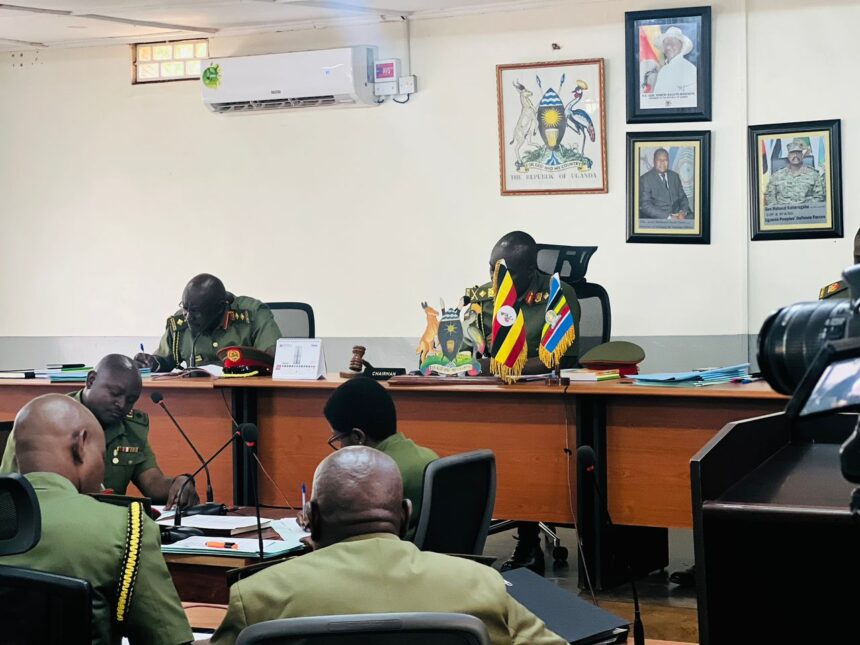
Following the restructuring, ten members of the General Court Martial were appointed, led by Brigadier General Richard Tukachungurwa as head of the court. Brig. Gen. Tukachungurwa, who previously served as Judge Advocate of the court, replaces Brigadier General Robert Freeman Mugabe. After taking the required judicial oath, the newly appointed officers officially resumed the court’s work, marking a new phase in the administration of military justice.
On its first day back in session, the court began hearing a case involving 12 accused persons—one UPDF officer and 11 civilians—allegedly involved in murder, aggravated robbery and kidnap with intent to murder. The charges are brought under the Penal Code Act, and the matter is currently before the court for plea taking.
The trial of the 11 civilians is grounded in Section 117(1)(a) of the UPDF Act, which provides that civilians who voluntarily act as accomplices in offences committed by UPDF officers fall within the ambit of military law. This provision was central to debates surrounding the Supreme Court ruling and remains a focal point in discussions about the balance between military and civilian jurisdiction.
The resumption of the General Court Martial under the revised legal framework signals the government’s attempt to respond to judicial scrutiny while maintaining the operational authority of military courts. As proceedings continue, attention is likely to focus on how the reformed system navigates questions of fairness, independence and constitutional compliance in handling both military personnel and civilians.