


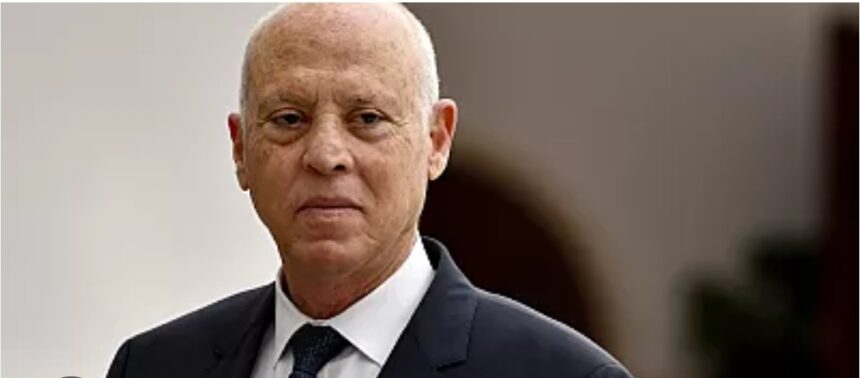
A Tunisian court has sentenced lawmaker Ahmed Saidani to eight months in prison over social media posts that mocked President Kais Saied following recent deadly floods.
Saidani was arrested earlier this month after publishing comments on Facebook criticizing the president’s visits to flood-affected areas. In one post, he sarcastically referred to Saied as the “supreme commander of sanitation and rainwater drainage,” a remark authorities deemed offensive.
On Thursday, a judicial official confirmed that Saidani had been convicted on charges of insulting others through communication networks. The case was reportedly brought under a telecommunications law that criminalizes “harming others via social media,” an offence that carries a penalty of up to two years in prison.
Saidani’s lawyer, Houssem Eddine Ben Attia, told AFP news agency that his client was being prosecuted under provisions regulating online communication. He criticized the proceedings, arguing that they undermine freedom of expression and the role of elected officials in holding the executive accountable.
The controversy comes in the wake of devastating floods that struck Tunisia last month after the country experienced its heaviest rainfall in more than 70 years. At least five people were killed and several others remain missing, with significant damage reported in the capital, Tunis, and surrounding regions.
In his posts, Saidani accused the president of focusing on public relations appearances rather than substantive governance. He also alleged that Saied monopolizes decision-making while avoiding responsibility when problems arise.
Fellow MP Bilel Mechri criticized the arrest, telling Reuters that detaining a parliamentarian for expressing critical views raises concerns about institutional independence. “How can parliament hold the executive authority to account if it carries out an unlawful arrest over critical views?” Mechri asked.
Saidani was elected to parliament in 2022 and was once considered supportive of Saied’s consolidation of power, including measures that saw opposition figures detained and key political institutions restructured. However, he has more recently emerged as a vocal critic of the president.
President Saied was elected in 2019 on a platform promising political reform and stability after years of upheaval following the 2011 uprising that ousted long-time ruler Zine al-Abidine Ben Ali during the Arab Spring.
The sentencing of Saidani adds to ongoing debates within Tunisia about freedom of expression, the use of telecommunications laws, and the evolving balance of power between the executive and legislative branches amid the country’s shifting political landscape.