

On Tuesday this week the halls of Parliament of Uganda carried more than just the routine hum of legislative debate. Outside, in studios, bars, and makeshift rehearsal spaces, thousands of artists waited some anxiously, others defiantly for a decision that could redefine their livelihoods.
By day’s end, that decision came.
Parliament passed the Copyright and Neighbouring Rights (Amendment) Bill, 2025 a piece of legislation that many in the creative industry are already calling a long-overdue lifeline.
The Clause That Sparked a Movement
At the heart of the drama was Clause 9.
On paper, it seems straightforward: broadcasters, bars, hotels, and other commercial spaces must compensate artists when they use copyrighted music and creative works. But for Uganda’s creatives, this clause represents something deeper recognition, dignity, and economic justice.
For years, musicians have watched their songs fill nightclubs and dominate radio airwaves without receiving a fair share of the profits. The result? A thriving entertainment scene built on the backs of underpaid creators.
When concerns were raised in Parliament particularly by David Kabanda and echoed in discussions led by Speaker Anita Among—fears spread quickly. Many artists believed Clause 9 might be weakened or removed altogether.
What followed was unprecedented.
When Artists Found Their Voice
Within hours, Uganda’s creative sector mobilized.
From recording studios in Kampala to WhatsApp groups linking producers and performers across the country, a unified message emerged: do not tamper with Clause 9.
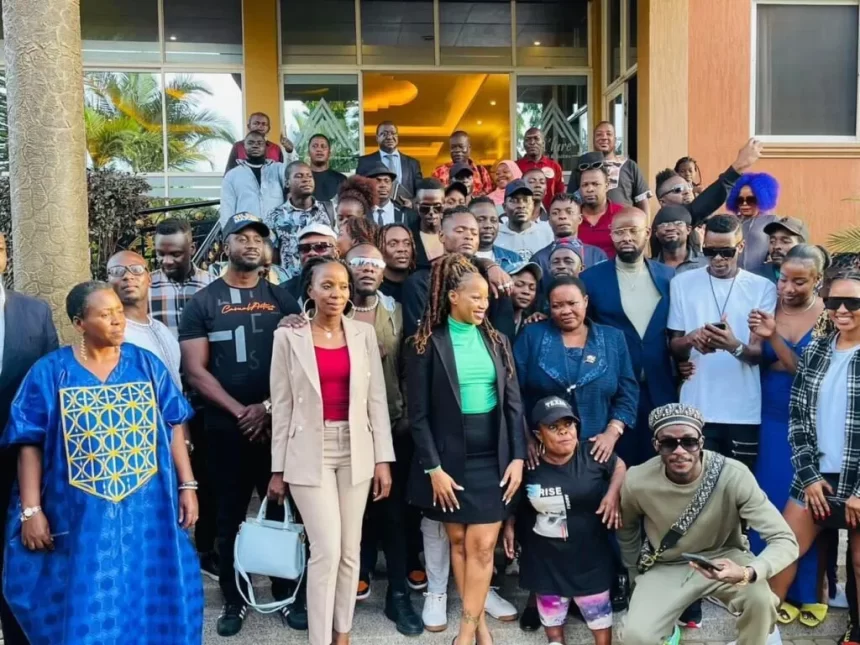
Leading the charge was Eddy Kenzo, who, beyond his music career, now serves as president of the Uganda National Musicians Federation and a presidential adviser on creatives. Alongside him were industry figures like Martin Yoyo, Jeff Ekongot, and Charles Batambuze—names that may not dominate charts but wield influence in the governance of creative rights.
Their approach was strategic. Formal petitions were drafted. Collective Management Organisations issued joint statements. And perhaps most critically, a closed-door meeting was secured with Speaker Among just hours before the final parliamentary sitting.
That meeting, insiders say, changed everything.
Behind Closed Doors
Inside that high-stakes meeting, tensions were high but focused. The Attorney General reportedly clarified key concerns, especially around how royalties would be collected and distributed, and the role of Collective Management Organisations in maintaining efficiency and fairness.
For artists, one issue stood out: the protection of a centralized system to manage royalties. Without it, they argued, enforcement would collapse into chaos.
By the time lawmakers returned to the chamber, the mood had shifted.
Clause 9 survived.
More Than a Law
The bill’s passage marks the culmination of a process that began in May 2025, when Norbert Mao introduced it as part of broader legal reforms.
But its significance stretches far beyond legislative timelines.
For Uganda’s creatives, this is about rewriting a long-standing imbalance. It introduces stronger mechanisms for royalty collection, tighter protections for digital content—including takedown provisions—and stricter penalties for unauthorized use.
In practical terms, it could mean that:
A song played in a bar generates income for its creator
A filmmaker earns from repeated broadcasts
A writer benefits when their work is reproduced commercially
The Road Ahead
The bill now awaits assent from President Yoweri Kaguta Museveni. If signed into law and published in the Gazette, it could usher in a new era for Uganda’s creative economy.
Yet, challenges remain.
Implementation will be everything. Will businesses comply? Will enforcement be consistent? And will artists especially those outside major urban centers actually see the financial benefits?
Still, for now, there is cautious optimism.
Because for perhaps the first time in a long time, Uganda’s artists didn’t just perform they influenced policy. They didn’t just entertain they negotiated power.
And in doing so, they may have changed the future of creativity in Uganda.