

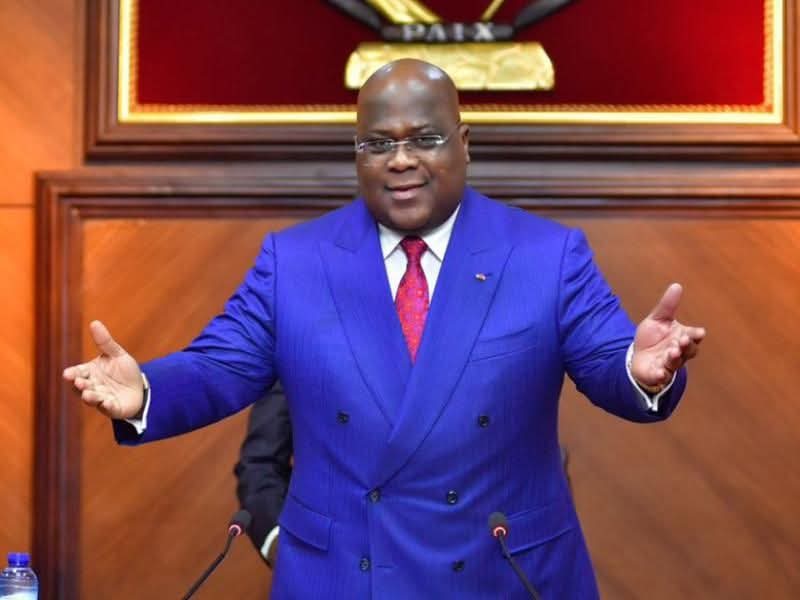
Political debate has intensified in the Democratic Republic of the Congo after President Félix Tshisekedi indicated that he could seek a third term in office if the Congolese people approve such a move through a referendum.
Speaking during recent remarks that have quickly drawn regional and international attention, Tshisekedi said he would accept another term beyond 2028 if that reflected the will of the people.
“If the people want me to have a third term, I will accept,” the Congolese leader reportedly said.
The comments have sparked fresh discussion about constitutional limits, democratic governance, and political stability in a country already grappling with insecurity and humanitarian challenges in its eastern regions.
Under the current Congolese Constitution, presidents are limited to two terms. Tshisekedi, who first assumed office in 2019 after winning the 2018 election, was re-elected in 2023 and is expected to complete his second and final constitutional term in 2028 unless changes are made to the law.
While the president did not directly announce plans to amend the Constitution, his remarks are widely being interpreted as opening the door to a possible referendum or future constitutional reform process.
Opposition figures and civil society actors have already begun expressing concern, warning that attempts to alter presidential term limits could deepen political divisions and undermine democratic institutions.
The debate mirrors a broader trend across several African countries where constitutional amendments related to presidential tenure have often generated controversy, protests, and political unrest.
Supporters of Tshisekedi, however, argue that any decision approved through a national referendum would represent the democratic will of the Congolese people rather than a unilateral extension of power.
The issue emerges at a delicate moment for the mineral-rich Central African nation, where government forces continue to battle armed groups in the east, particularly the M23 rebels, amid worsening displacement and regional diplomatic tensions.
Analysts say the president’s remarks could significantly shape the country’s political landscape over the next few years, influencing alliances, succession debates, and preparations for the post-2028 period.
Some observers also warn that discussions around extending presidential tenure risk diverting attention from pressing national priorities including security, economic recovery, governance reforms, and humanitarian needs.
Despite the growing debate, no formal constitutional amendment process has yet been announced by the Congolese government.
For now, Tshisekedi’s remarks have added a new layer of political uncertainty to an already fragile environment, setting the stage for what could become one of the country’s most consequential constitutional debates in recent years.