


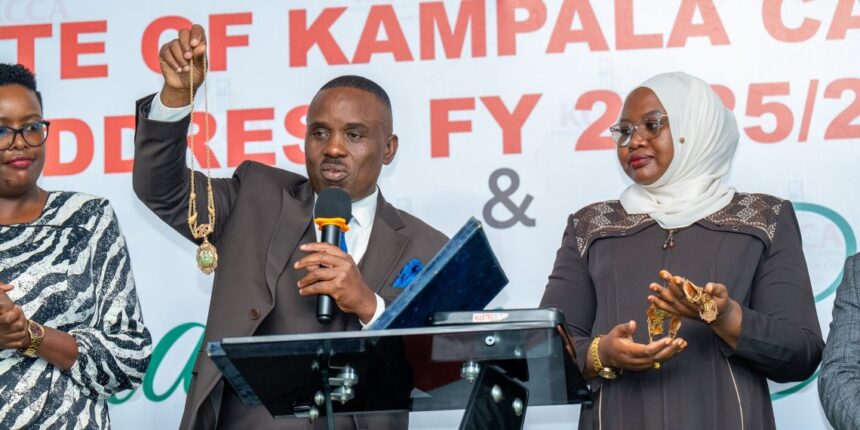
Outgoing Erias Lukwago has issued a strong warning to his successor, Daniel Kazibwe Balimwezo, urging him to aggressively pursue governance reforms at Kampala Capital City Authority if Kampala is to overcome its long-standing administrative and service delivery challenges.
Speaking during the official handover ceremony at City Hall, Lukwago cautioned that without structural changes to the KCCA governance framework, the capital risks remaining trapped in institutional conflicts, bureaucratic inefficiencies, and chronic underfunding.
“There is a need to push for reforms that will create a leaner and more efficient city administration capable of delivering services effectively,” Lukwago said.
The outgoing Lord Mayor specifically called for amendments to the KCCA Act, arguing that overlapping powers between elected political leaders and appointed technocrats have for years undermined effective governance and slowed decision-making processes within the city administration.
He also urged the incoming leadership to push for increased funding from central government, noting that Kampala contributes significantly to Uganda’s economy but continues to operate under financial constraints that affect roads, drainage systems, waste management, and urban infrastructure.
Balimwezo assumes office at a time when Kampala continues to struggle with worsening traffic congestion, flooding, poor sanitation, and pressure on public services amid rapid urban population growth.
Lukwago described his own 15-year leadership journey at City Hall as turbulent and heavily marked by political and institutional confrontations.
“It has not been a walk in the park. Out of all the mayors who have led Kampala since its inception, I may have had the most tumultuous tenure,” he said.
His administration, which began after he became Kampala’s first Lord Mayor under the KCCA arrangement in 2011, was frequently characterised by clashes with central government authorities over control of city affairs and the balance of power within the capital’s governance system.
Throughout his tenure, Lukwago repeatedly accused powerful interests of attempting to capture public assets and influence urban management decisions. He cited disputes surrounding Nakasero Market, Park Yard Market, and Nakivubo Channel among the major governance battles his administration faced.
He also blamed corruption, weak urban planning systems, and excessive political interference for slowing Kampala’s transformation into a modern city.
Despite the challenges, Lukwago maintained that his administration laid a foundation for accountability, civic awareness, and future institutional reforms.
As he exits office, Balimwezo now inherits both the opportunities and political complexities of managing Uganda’s capital city, with growing public expectations for improved service delivery and urban transformation.