
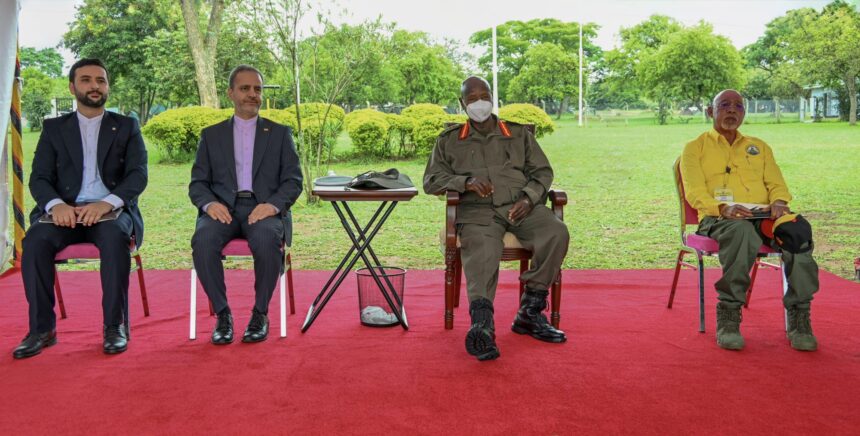
President Yoweri Kaguta Museveni on Sunday held a high-level meeting with Iran’s Ambassador to Uganda, Majid Saffar, on the sidelines of the NRM retreat Kyankwanzi 2026, amid growing diplomatic sensitivities linked to recent public statements by Uganda’s military leadership.
The meeting comes at a time when remarks by the Chief of Defence Forces, Muhoozi Kainerugaba, have drawn international attention, particularly regarding the Middle East conflict and Uganda’s perceived alignment.
Museveni confirmed the engagement, describing it as part of ongoing diplomatic relations. He noted that discussions focused on areas of mutual interest and cooperation between Uganda and Iran, although official details of the talks were not disclosed.
Diplomatic concerns behind closed doors
Sources familiar with the meeting indicated that the Iranian delegation sought clarification on Uganda’s official position following a series of outspoken comments by Gen Muhoozi. The CDF had publicly expressed strong support for Israel, including suggestions of Uganda’s readiness to back Israeli interests and criticism of positions aligned with Iran and Turkey.
The meeting was also attended by Foreign Affairs Minister Jeje Odongo, highlighting the seriousness of the diplomatic engagement.
Ambassador Saffar has in recent months stepped up engagements with Ugandan officials, signaling Tehran’s intention to deepen cooperation across sectors such as trade, agriculture, and technology. His outreach comes amid heightened global tensions involving Iran, the United States, and Israel.
Strain on Uganda’s non-aligned stance
Uganda has traditionally pursued a non-aligned foreign policy, balancing relations across competing global powers. However, Gen Muhoozi’s public statements—shared widely on the platform X—have raised questions about whether that posture is shifting.
The situation has also created diplomatic ripples with Turkey, prompting intervention from Uganda’s Permanent Secretary in the Ministry of Foreign Affairs, Adonia Ayebare, who moved to ease tensions and reaffirm Uganda’s commitment to constructive engagement with its partners.
Uganda’s ties with Iran date back decades, with notable engagements including the 2023 visit of Iranian President Ebrahim Raisi, which yielded cooperation agreements in areas such as agriculture, visa facilitation, and political coordination.
At the same time, Uganda maintains long-standing historical ties with Israel, shaped in part by the Entebbe raid 1976, a defining moment in the country’s geopolitical history.
Museveni, who currently chairs the Non-Aligned Movement, has consistently emphasized Uganda’s commitment to maintaining diversified partnerships without taking sides in global conflicts.
Managing a delicate balance
Analysts warn that increasingly vocal “military diplomacy” could complicate Uganda’s carefully managed foreign relations, especially at a time of heightened tensions in the Middle East.
The Kyankwanzi meeting is therefore seen as a strategic effort by Kampala to reassure international partners and maintain diplomatic balance. While internal voices may project differing geopolitical positions, Uganda’s official stance appears to remain anchored in non-alignment.
As consultations continue behind the scenes, the government faces the challenge of preserving its foreign policy credibility while navigating an increasingly polarized global environment.