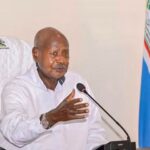


The Supreme Court on Thursday formally brought to an end Robert Kasibante’s challenge to the January 15, 2026 presidential election after granting him leave to withdraw his petition against President Yoweri Museveni’s re-election.
Although the bench unanimously allowed the withdrawal, it split sharply on the question of legal costs — a divergence that now frames the broader constitutional debate arising from the case.
A Divided Court on Costs
The majority ruled that each party should bear its own costs, effectively shielding Kasibante from financial liability. The justices reasoned that presidential election petitions are matters of profound public interest and that imposing heavy costs on withdrawing petitioners could discourage future litigants from seeking judicial redress in electoral disputes.
However, in a forceful dissent, Justice Christopher Madrama Izama argued that the court had departed from the clear and mandatory wording of the Presidential Elections Act.
The Act provides that where a petitioner withdraws an election petition, he “shall” be liable to pay costs. In legal drafting, the word “shall” is typically interpreted as mandatory rather than discretionary.
For Justice Madrama, this was not a matter of sympathy or political prudence but one of statutory fidelity.
“A candidate who initiates a national challenge such as this must have evidence robust enough to stand on its own and must be ready to take on the financial challenges that come with it,” he wrote, emphasizing that the court lacked authority to dilute Parliament’s directive.
The 2026 Electoral Context
The 2026 presidential results themselves were decisive. According to the Electoral Commission, President Museveni secured 7,946,772 votes, representing 71.65 percent of valid ballots cast.
His closest challenger, Robert Kyagulanyi, garnered 2,741,238 votes or 24.72 percent. Further behind were:
Nathan Nandala Mafabi — 209,039 votes (1.88%)
Mugisha Gregory Muntu — 59,276 votes (0.53%)
Frank Bulira — 45,959 votes (0.41%)
Robert Kasibante — 33,440 votes (0.30%)
Mubarak Munyagwa — 31,666 votes (0.29%)
Joseph Mabirizi — 23,458 votes (0.21%)
Kasibante finished sixth in an eight-candidate race, trailing the declared winner by more than 7.9 million votes.
Yet Justice Madrama’s dissent underscores that the central issue before the court was not electoral margins, but the interpretation of statutory command.
Public Interest vs. Legislative Mandate
The majority framed their decision as a contribution to post-election reconciliation and national stability. In their view, presidential election petitions transcend private disputes and occupy a unique place in constitutional governance. Imposing financial penalties on withdrawing petitioners could chill access to the Supreme Court and weaken democratic accountability.
Justice Madrama, however, cautioned against substituting equitable considerations for clear legislative language. In his view, waiving mandatory cost provisions in politically sensitive cases risks undermining predictability in electoral jurisprudence.
A presidential election petition, he noted, is no ordinary civil matter. It mobilizes the Supreme Court, the Attorney General, the Electoral Commission, and extensive state resources. It temporarily suspends political finality and subjects the national mandate to judicial scrutiny.
When such a petition is withdrawn due to financial strain, the costs do not vanish — they are absorbed by the public.
The Precedent Question
Kasibante cited the prohibitive expense of sustaining the petition as grounds for withdrawal. While that explanation may evoke sympathy, Justice Madrama’s dissent suggests it simultaneously strengthens the argument for strict adherence to statutory cost provisions.
If withdrawal carries no financial consequence, critics argue, the threshold for filing petitions may be lowered, potentially encouraging speculative or symbolic litigation.
The precedent dimension also looms large. In 2016, a similar petition was filed by John Patrick Amama Mbabazi following a presidential contest primarily between President Museveni and Kizza Besigye. That petition ran its full course, and established cost principles were applied.
Consistency across electoral cycles, observers note, strengthens public confidence in judicial neutrality and institutional continuity.
A Case Closed, But Questions Remain
With the petition formally withdrawn, the legal challenge to the January 15 election is now conclusively closed. President Museveni’s re-election stands undisturbed.
Yet the division within the Supreme Court signals that the debate over statutory interpretation, judicial discretion, and the financial consequences of electoral litigation is far from settled.
In the end, the Kasibante petition may be remembered less for its electoral claims and more for the jurisprudential fault line it exposed: whether courts, in moments of political sensitivity, may temper legislative command in the name of public interest — or whether fidelity to statutory language must remain absolute.