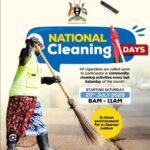


The Government of Uganda has officially designated the last Saturday of every month as National Cleaning Day, introducing a mandatory nationwide sanitation exercise aimed at improving hygiene, reducing disease outbreaks, and promoting a cleaner environment.
Under the new directive, all Ugandans will be expected to participate in community cleaning activities from 7:00 a.m. to 10:00 a.m. During this period, non-essential movement will be prohibited, businesses will remain closed, and only emergency and security vehicles will be allowed on the roads.
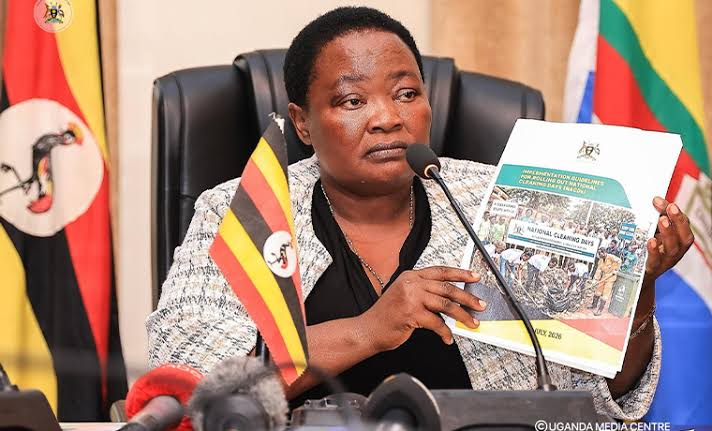
Prime Minister Robinah Nabbanja announced the initiative on Thursday at the Office of the Prime Minister during a meeting attended by officials from the Ministry of Health, Ministry of Local Government, Kampala Capital City Authority (KCCA), the Uganda Police Force, and the National Environment Management Authority (NEMA).
Nabbanja said the programme follows a Cabinet resolution reached on August 11, 2025, during a meeting chaired by President Yoweri Museveni, after concerns over poor sanitation and its impact on public health.
According to the Prime Minister, government data shows that nearly 75 percent of diseases in Uganda are linked to poor sanitation and hygiene, with malaria, diarrhoea, and typhoid among the country’s leading preventable illnesses.
She also highlighted Kampala’s growing waste management challenge, noting that the city generates thousands of tonnes of solid waste daily, yet only 50 to 60 percent is collected and properly disposed of. The remaining waste, she said, blocks drainage channels, pollutes the environment, and increases the risk of disease outbreaks.
Citing Ministry of Health statistics, Nabbanja said about 33 children die every day from sanitation and hygiene-related illnesses, prompting Cabinet to invoke Article 39 of the Constitution, which guarantees every Ugandan the right to a clean and healthy environment.
“The National Cleaning Day initiative will run from 7:00 a.m. to 10:00 a.m. on the last Saturday of every month. During this period, all Ugandans are expected to participate in organised cleaning activities within their communities, including roads, drainage channels, markets, schools, health facilities, places of worship and other public spaces,” Nabbanja said.
She added that local governments will coordinate the exercise by mobilising communities, identifying priority areas, and supervising implementation. Detailed operational guidelines are expected to be issued following the official launch of the initiative in Kisenyi, Mengo, where the Vice President is expected to officiate.
Health Minister Dr. Chris Baryomunsi called on the public to support the initiative, describing sanitation as a collective responsibility that directly influences public health.
Responding to concerns raised by members of the Seventh-day Adventist Church, whose main day of worship falls on Saturday, Baryomunsi said the exercise had been scheduled in the early morning to minimise disruption to religious activities.
Meanwhile, Deputy Inspector General of Police James Ochaya said the Uganda Police Force is prepared to enforce compliance with the directive, noting that officers will oversee the movement restrictions while ensuring public safety during the monthly exercise.