
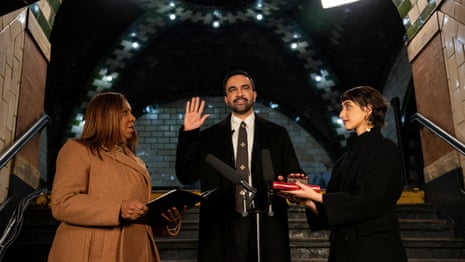
Zohran Mamdani, who has made history as New York City’s first Muslim mayor and the first of South Asian descent, delivered his maiden public address on New Year’s Day shortly after being sworn into office at City Hall.
The historic ceremony was officiated by US Senator Bernie Sanders of Vermont, a long-time ally and fellow democratic socialist, underscoring the ideological foundations of Mamdani’s political rise.
Addressing a large and jubilant crowd moments after taking the oath, Mamdani began by acknowledging the teams that supported him throughout his political journey, from grassroots organising to City Hall.
“Thank you to my teams, from the Assembly, to the campaign, to the transition and now, the team I am so excited to lead from City Hall,” he said.
He then turned to his family, offering a deeply personal reflection on the formative experiences that shaped his worldview—experiences rooted partly in Uganda.
“Thank you to my parents, Mama and Baba, for raising me, for teaching me how to be in this world, and for having brought me to this city,” Mamdani said. “Thank you to my family, from Kampala to Delhi. And thank you to my wife, Rama, for being my best friend and for always showing me the beauty in everyday things.”
Mamdani’s parents lived and worked in Kampala before relocating abroad, a period that family members and close associates say played a significant role in shaping his understanding of inequality, multicultural coexistence and public service. Those values, they note, later became central to his political identity.
From Uganda, the family lived across several continents before eventually settling in New York—a city Mamdani has frequently described as being built by migrants and working families like his own.
His political career began in community organising before he was elected to the New York State Assembly, where he emerged as a leading voice on housing justice, public transport reform and workers’ rights.
In his address, Mamdani emphasised that his election was powered by ordinary citizens rather than political elites.
“Most of all, thank you to the people of New York,” he said. “A moment like this comes rarely. Seldom do we hold such an opportunity to transform and reinvent. Rarer still is it the people themselves whose hands are the ones upon the levers of change.”
As he begins his term, Mamdani pledged to lead an administration grounded in inclusion, fairness and shared dignity—principles he traced back to his family’s journey across continents, including their time in Uganda, and to the diverse communities that define New York City.