
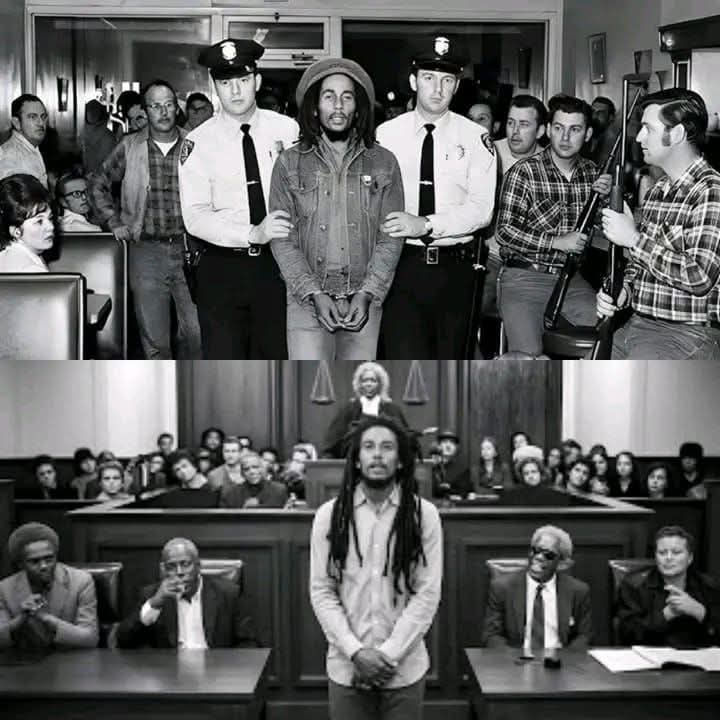
The courtroom was tense long before proceedings began. By 9 a.m., every bench inside the Supreme Court was filled—lawyers, journalists, curious citizens, and devoted fans all waiting to witness what many feared could mark the end of a musical era.
At the center of it all sat Bob Marley—not with a guitar, but as a defendant.
He faced serious charges: inciting public disorder through what the state called “seditious music.” If convicted, he risked years behind bars and a ban from performing in Jamaica. For a man whose voice had become synonymous with unity and resistance, the stakes could not have been higher.
A Concert That Sparked Fear
The case traced back to a powerful performance weeks earlier at Kingston’s National Stadium. Marley had taken the stage and delivered one of his most iconic songs, Get Up, Stand Up, dedicating it to people living under political and social oppression.
The crowd—15,000 strong—rose as one.
Fists in the air. Voices united. A moment of raw collective energy.
To many, it was inspiring.
To some in power, it was alarming.
Within days, complaints reached the Attorney General’s office. Marley’s music, critics argued, was no longer entertainment—it was agitation. A warrant was issued. And soon, the man who sang about freedom was standing trial for it.
The Case Against a Voice
The prosecution came prepared, armed not with weapons—but lyrics.
Attorney General Harold Morrison presented Marley’s songs as evidence of dangerous influence. Lines from Burnin’ and Lootin’, I Shot the Sheriff, and Get Up, Stand Up were read aloud, stripped of melody and context.
“These are not harmless words,” Morrison argued. “They are calls to defiance. Calls to rebellion.”
Witnesses followed:
A police commissioner linked Marley’s popularity to rising protests.
A school principal claimed students had become “ungovernable.”
A politician described concerts as “political rallies in disguise.”
The narrative was clear: Marley’s music was destabilizing society.
The Defense: A Different Interpretation
Marley’s legal team pushed back, reframing the same lyrics as messages of hope, justice, and peaceful resistance.
A sociology professor testified that Marley’s music had actually reduced violence, helping bridge deep political divides in Jamaica. Community leaders spoke of transformation—not rebellion.
But the turning point wasn’t expert testimony.
It was Marley himself.
When the Accused Spoke
Called to the stand, Marley remained calm, measured, and unwavering.
“My music comes from Jah,” he told the court. “It speaks about love, unity, and standing up for what’s right.”
When challenged about encouraging resistance, he drew a line that shifted the room:
“Standing up for your rights is not the same as breaking the law. Sometimes the law itself is wrong.”
Even when pressed on I Shot the Sheriff, Marley explained it as metaphor—a story of resisting oppression, not promoting violence.
Then came the question that defined the trial:
“If the court bans your music, will you obey?”
Marley paused.
“I would respect the court… but I must follow my conscience. I would rather go to prison for speaking truth than be free for staying silent.”
The Moment That Changed Everything
As arguments concluded, the judge—Patricia Williams—made an unusual request.
She asked Marley to sing.
Not for performance. Not for spectacle. But for understanding.
Standing in the courtroom, without instruments, Marley began Redemption Song.
His voice filled the space—raw, unfiltered, deeply human.
“Emancipate yourselves from mental slavery…”
The courtroom fell silent.
Some wept. Others bowed their heads. Even officers of the court were visibly moved.
For a moment, the law paused—and humanity took center stage.
The Verdict
When the song ended, the silence lingered.
Judge Williams spoke carefully, her tone changed.
“What I heard was not sedition,” she said. “What I heard was pain transformed into hope… a man singing about freedom—not from law, but from injustice.”
Then came the ruling:
Not guilty.
The courtroom erupted. Cheers, tears, embraces.
But beyond the celebration, something deeper had happened.
A Legacy Beyond the Courtroom
The case would go on to shape legal thinking about artistic expression—not just in Jamaica, but across the Caribbean and beyond.
It established a powerful principle:
Art that challenges injustice is not a crime—it is a form of civic voice.
For Marley, the experience became part of his message.
“They tried to put I in prison for singing about freedom,” he would later say.
“But freedom can’t be imprisoned.”
More Than a Trial
What unfolded that day was never just about one man.
It was about the power of music.
The fear of truth.
And the thin line between authority and freedom.
In the end, the court didn’t silence Bob Marley.
It amplified him.
Because sometimes, the most powerful testimony… isn’t spoken.
It’s sung.