

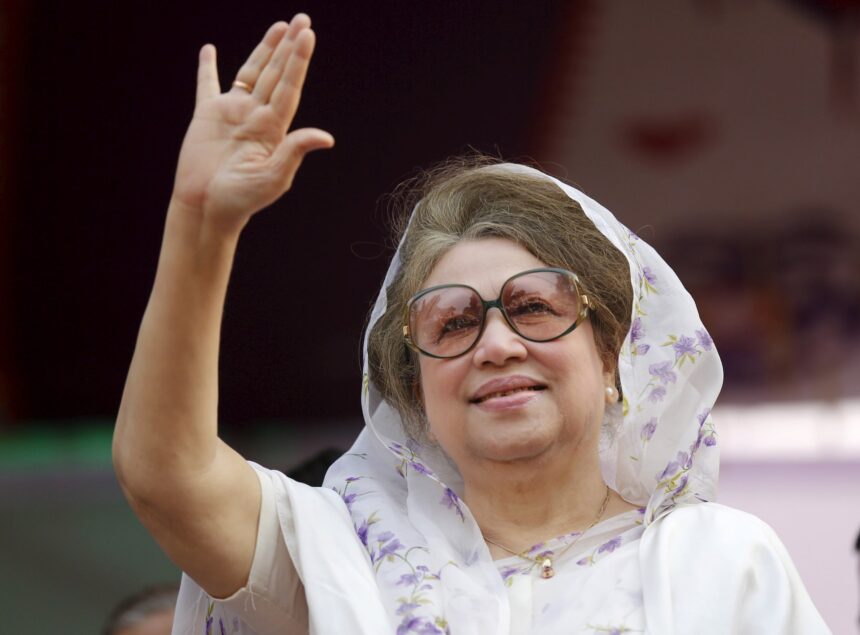
Bangladesh’s first female prime minister and veteran opposition leader, Khaleda Zia, has died at the age of 80 after a prolonged illness, her party has announced.
“Our favourite leader is no longer with us. She left us at 6am this morning,” the Bangladesh Nationalist Party (BNP) said in a statement posted on Facebook on Tuesday.
Doctors had earlier described Zia’s condition as “extremely critical” after she was placed on life support on Monday night. Physicians said her advanced age and deteriorating health made it impossible to administer multiple treatments simultaneously.
Khaleda Zia made history in 1991 when she became Bangladesh’s first female head of government, leading the BNP to victory in the country’s first democratic elections in two decades following years of military rule. Her ascent marked a major milestone in Bangladesh’s political landscape and ushered in a new era of competitive multiparty politics.
She returned to office in 2001 for a second term as prime minister, serving until October 2006, when she stepped down ahead of general elections. Zia’s political career, however, was often overshadowed by intense rivalry with Sheikh Hasina, leader of the Awami League, a feud that defined Bangladesh’s politics for decades. Hasina herself was ousted from power last year.
The widow of former president Ziaur Rahman, who was assassinated in 1981, Khaleda Zia inherited a powerful political legacy that helped shape the BNP into one of Bangladesh’s dominant political forces. Supporters credit her with strengthening democratic institutions, while critics accuse her of mismanagement and fostering political polarization.
In 2018, Zia was sentenced to five years in prison on corruption charges, a case her supporters described as politically motivated. Her imprisonment and subsequent health complications significantly curtailed her active participation in politics in recent years.
Tributes have begun pouring in from across Bangladesh and beyond, with supporters hailing her as a symbol of resilience and a trailblazer for women in leadership, while political rivals acknowledged her central role in shaping the country’s modern political history.
Funeral arrangements and official mourning plans are yet to be announced.