
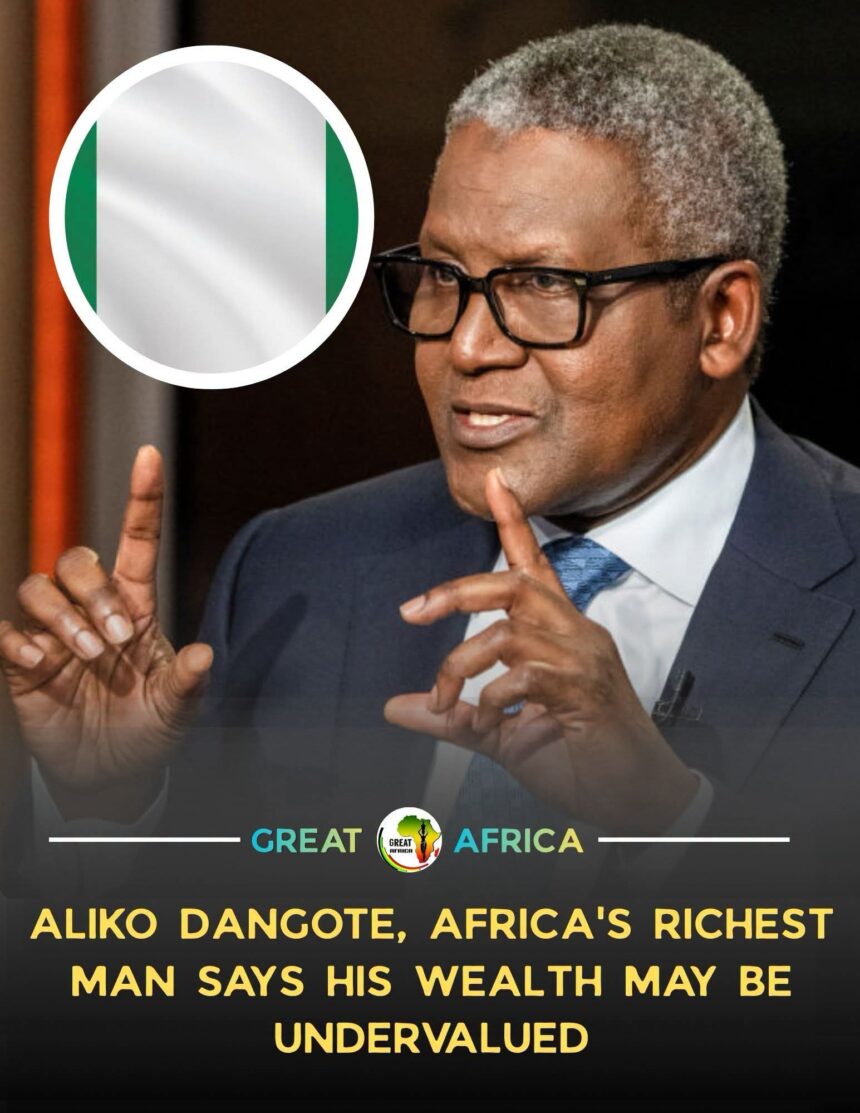
Africa’s richest businessman, Aliko Dangote, has suggested that his true net worth could be far higher than figures published by global wealth rankings, arguing that many of his most valuable business interests remain privately held and are therefore difficult to accurately value.
Speaking during an interview with James Dumoulin of School of Hard Knocks, Dangote revealed that his companies generated approximately $10 billion in revenue during the first quarter of the year, underscoring the scale of the business empire he has built across Africa.
The Nigerian billionaire questioned estimates of his fortune, which currently place his wealth at between $31.6 billion and $35.6 billion, making him one of the richest individuals globally. He noted that several of his largest investments are not publicly listed on stock exchanges, meaning their full value is often not captured by international wealth trackers.
Dangote’s business empire spans multiple sectors, including cement manufacturing, fertilizer production, sugar refining, and petroleum processing. His investments have transformed him into one of Africa’s most influential industrialists and a leading advocate for economic self-sufficiency on the continent.
Among his most ambitious projects is the Dangote Refinery, one of the world’s largest single-train oil refineries, which is expected to significantly reduce Africa’s dependence on imported petroleum products and strengthen regional energy security.
When asked how he would like history to remember him, Dangote offered a concise but striking response.
“As somebody who industrialized Africa.”
The statement reflects a vision that has guided much of his business career. For decades, Dangote has argued that Africa’s long-term prosperity depends on building strong manufacturing industries capable of producing goods locally rather than relying heavily on imports.
Economic analysts credit his investments with creating thousands of jobs, supporting regional supply chains, and encouraging industrial development across several African countries. His companies have become major players in sectors considered critical to economic transformation and infrastructure development.
As African governments increasingly prioritize industrialization as a pathway to economic growth, Dangote’s influence continues to extend beyond business into broader discussions about development, self-reliance, and the continent’s future competitiveness in the global economy.
Whether measured by official wealth rankings or the scale of his industrial footprint, Dangote’s legacy is increasingly being defined not only by his fortune but by his efforts to reshape Africa’s economic landscape through large-scale manufacturing and investment.