
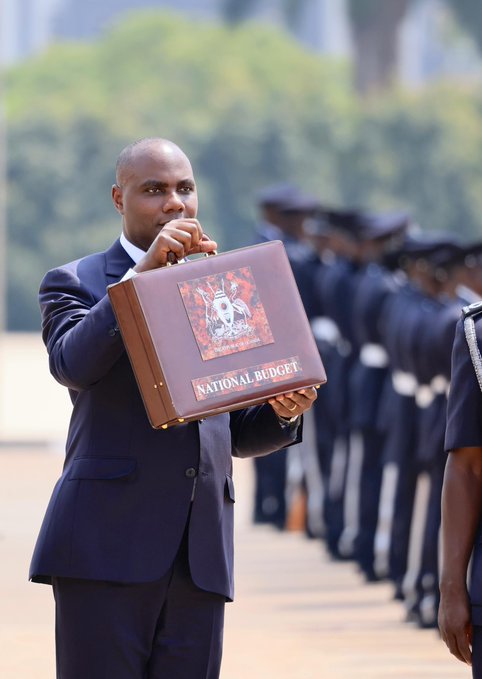
Government has projected domestic revenue collections of Shs35.7 trillion for the 2026/27 financial year, up from Shs32.3 trillion collected in the previous fiscal year, as it intensifies efforts to finance national development through locally generated resources.
Presenting the government’s fiscal outlook, Uganda’s Minister of Finance, Planning and Economic Development, Henry Musasizi said the increased revenue target reflects government’s commitment to strengthening economic self-reliance and reducing dependence on external financing.
According to Musasizi, domestic revenue generated from taxes, non-tax revenue, and local government collections financed approximately 80.9 percent of Uganda’s discretionary budget of Shs44.1 trillion during the 2025/26 financial year.
The minister described domestic revenue mobilization as more than a budgetary necessity, arguing that it is central to Uganda’s long-term sovereignty and economic resilience.
“Increasing domestic revenue is not merely a fiscal objective. It is a sovereignty objective,” Musasizi said.
He noted that countries capable of funding a significant share of their development priorities from internal resources enjoy greater policy independence, stronger economic resilience, and improved sustainability.
Government officials say the revenue growth strategy will focus on broadening the tax base, improving tax administration, enhancing compliance, and expanding economic activity across key sectors.
The projected increase comes at a time when many developing countries are grappling with rising debt obligations and tightening external financing conditions, prompting governments to place greater emphasis on domestic resource mobilization.
Economic analysts note that stronger domestic revenue performance could reduce Uganda’s reliance on borrowing and development assistance while providing more predictable funding for infrastructure, social services, and wealth creation programmes.
However, experts also caution that achieving the ambitious target will require sustained economic growth, improved tax compliance, and continued formalization of businesses operating in the informal sector.
The revenue projections form part of government’s broader strategy to support the country’s development agenda while maintaining fiscal discipline and strengthening Uganda’s economic independence.
As government prepares to implement the 2026/27 budget, domestic revenue collection is expected to remain a key pillar in financing public investment, service delivery, and socio-economic transformation programmes across the country.